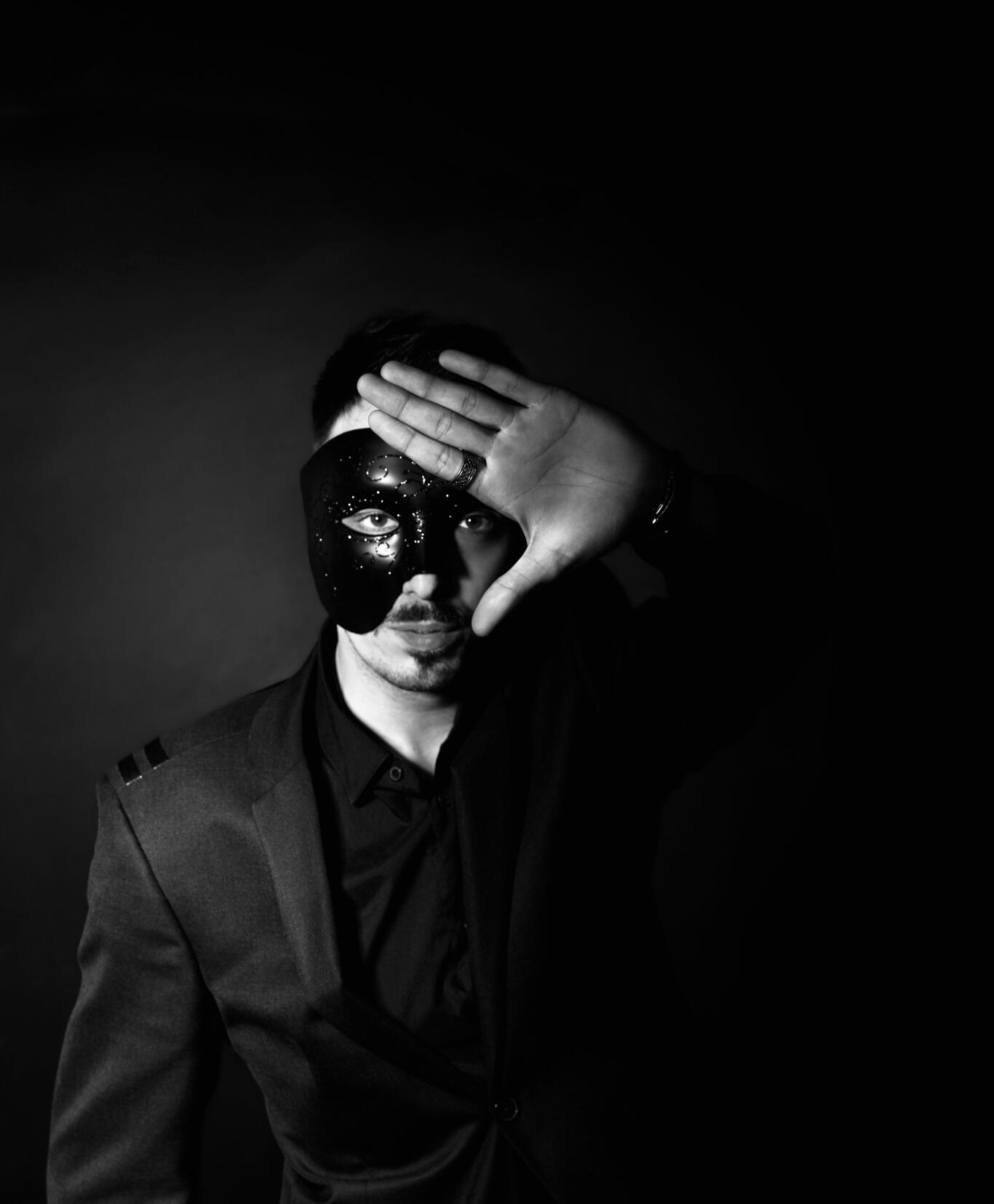
BLACK MASK
Decisions produce apparent rationality. Until their cost goes silent in time. Black Mask isolates the point where logic breaks down – before the error is financed and ultimately revealed in the outcome.This is not narrative.
This is the architecture of seeing.Black Mask – a diagnostic system for structural decision failure.Before the cost. Not after.
WHERE COST BEGINS
The cost of a rational-looking choice rarely reveals itself at the moment it is made.Narrative does not reveal it.
Reports do not reveal it.
Only the outcome does – when correction is already expensive.Between the decision and the outcome there is a point where narrative starts replacing facts. From that point, cost accumulates silently – before any number shows it. Black Mask enters before execution. While the error is still reversible. This is not an advisory process. This is not retrospective analysis.This is a logic failsafe – before the error takes hold.

Logic isolation before the error is financed.
THE INFRASTRUCTURE
OF SEEING
Black Mask does not interpret reality. It separates: facts from intent, outcome from narrative, action from the meaning assigned after the fact. The system isolates apparent rationality that generates systemic loss – and locates the moment when "safe" status becomes an illusion.

Zero interpretation.
Zero intent.
Zero narrative.
The system works on one axis: facts. A decision either stands on them – or on the story told about them.
BLACK MASK SIGNALS
Errors rarely stem from a lack of tools or competence. More often, they result from a fracture in the architecture of decisions. Seven identifiers of logic debt – proof that an organization is financing narrative coherence at the cost of seeing.
Signal 01 – Strategy Without Ownership
Strategy exists, but no one carries the cost of its error.
Signal 02 – Decisions Protected by Narrative
Justification matters more than measurable consequence.
Signal 03 – Pressure Disguised as Necessity
Time or market pressure replaces a real choice.
Signal 04 – Structure Without Authority
Formal structure exists. Real decision power lies elsewhere.
Signal 05 – Logic That Escalates Cost
Local logic guarantees systemic loss.
Signal 06 – Repetition Treated as Incident
A repeatable failure is called an "exception."
Signal 07 – Change That Preserves the Problem
Change designed not to disturb the source of the error.
How to read this:
One signal – observe.
Several – this is not an execution problem.
Most of them – this is the moment for System Diagnostic.If you recognize none – Black Mask is not something you need.
STRUCTURAL LOGIC DRIFT
The constraint was visible. On the record before the decision – in the company's own reporting, or documented in the conduct of its own suppliers. Not applied. Across seven closed observations: a Chapter 11 filing, $19.5B in write-downs, a $12.4B impairment, 21,000 roles cut and $23.7B of negative free cash flow at Oracle, and the first negative free cash flow on record at Alphabet. At Crest Nicholson, the observation was timestamped 28 days before the outcome. At Alphabet, the largest company in the record, 89 days. One observation remains open: Novo Nordisk. The first data point passed on 4 August without resolution. Next: 4 November. Eight companies. Eight industries. One structural pattern.
THE ENTRY POINT
Black Mask is not for you because of who you are. It is for you because of the moment you are in.
You are in the right moment if:
► A decision was made. The cost appeared later. The connection was never formally established.
► You have data, reports, experts – and still no single picture of where the loss originates.
► You no longer want recommendations. You want to see the facts that force the decision.
You are not in the right moment if:
► You are looking for a solution, a plan, or an action checklist.
► You need confirmation – not confrontation with facts.
► You want a process that reassures – not one that reveals.If you are still asking "is this for me?" – it probably isn't.
CORE
5000 €
One conversation. One decision.I don't build strategies.
I don't look for solutions.
I name facts.Where value actually originates. Where cost appears. At which moment the decision detaches from facts.
What you receive after the conversation – a map of facts:
► three facts of value,► three facts of cost,► two blind zones,► one decision moment.A record in the language of facts – not recommendations.Core ends with seeing. The choice is yours.
Core is not for you if:
► You're looking for an action plan.► You want a solution for "what to do next."► The stakes of the decision are reversible.
PARTNERSHIP
10 000 €
Partnership secures one decision: which of the candidates you're considering can safely be given a mandate. This is not choosing a partner for you. It's verification of whether a candidate can accept a mandate – or is only selling actions.
How it works:
You bring 1–3 candidates (people or companies) you're considering.I verify them through three safety criteria:► whether they take responsibility in the language of outcomes – not actions,► whether they have clear boundaries of mandate,► whether they have an early warning mechanism before cost appears.
Two possible outcomes:
Which candidate is safe – with justification and boundaries of mandate.
OR
STOP – no candidate is safe. The decision is secured by not letting anyone in at this stage. Partnership ends with a choice. I don't search for partners. I don't enter operations.
Partnership doesn't make sense when:
► The decision to act hasn't been made yet.► You don't know what you want to hand off.► You don't have candidates to verify.► The problem concerns multiple decisions at once.
SYSTEM DIAGNOSTIC
Individual pricing
System Diagnostic operates when the problem doesn't lie in a single decision but in the way a company makes decisions. This is not an extension of Core. It's a diagnostic of a system that produces its own errors – even when every decision looks logical.
When System Diagnostic makes sense:
► The error repeats in different forms.► The problem penetrates multiple areas simultaneously.► The consequences of decisions are difficult or irreversible.► Cost returns despite corrections.
How it works:
The process starts with seven questions that determine whether System Diagnostic makes sense at all. The qualification can end four ways: System Diagnostic, Core first, not yet – or STOP. If it makes sense – you go through detailed diagnostic questions.Based on that, I isolate the systemic error and deliver:► immediate visibility for the board,► the error mechanism – how the system itself produces cost,► critical points – where the decision stops being safe,► conditions for stopping the error.
What System Diagnostic does not do:
It does not create action plans. It does not recommend strategies. It does not enter operations.
System Diagnostic ends with a diagnosis. Further decisions are yours.
Pricing:
Individual – dependent on the scope of the problem, the stakes of risk, how deeply the mechanism is hidden, the distribution of responsibility, and whether the error is recurring. Three thresholds: local, structural, systemic.
RISK CLASSIFICATION
Core and Partnership isolate incident risk, a single decision, here and now. If the friction doesn't stem from one choice, but from a flawed decision architecture across the entire structure – Core won't reach it. That is the moment for System Diagnostic. System Diagnostic doesn't protect one decision. It protects the way decisions are made. If you're not sure whether your problem is an incident or a mechanism, that is exactly the thing to verify first.
SYSTEM BOUNDARIES
Black Mask operates before execution – at the moment when a decision looks rational, but its cost has already begun. The process stops before consequences appear in the results.
What Black Mask does not do:
It does not create strategies.
It does not manage implementation.
It does not take operational responsibility.Black Mask ends with seeing. Implementation is up to you or your partners.
When Black Mask is not needed:
When the stakes are symbolic – the system is unnecessary.
When the stakes are real – the absence of a system is a cost in itself.
THEATRE vs DECISION
Zero opinions. Zero narrative. Zero actions that are only there to "look good."Black Mask isolates the choice at the critical point, when:- facts are no longer enough to defend the chosen direction,
- cost begins to hide under layers of justification,
- the choice starts requiring fabricated theory to still look reasonable.
The choice is still yours – but it is made under conditions of full visibility of consequences.
Black Mask does not sell narrative.
It protects decisions – before they become cost.
Black Mask – a diagnostic system for structural decision failure.